
As a business owner, you may find yourself a bit overwhelmed by all of the “advice” out there as to how to effectively evaluate your company. But there is one tool that has proved itself time and time again. Regardless of industry, it provides a balanced look at your company and its place in the market. But what is it and how difficult is it to implement?
Here we break down the SWOT analysis so that you can quickly and efficiently incorporate it into your standard of business. According to Cole Abbott, the concept of SWOT analysis can be traced back to the early 1960s to American business management consultant Albert S. Humphrey, who worked at the Stanford Research Institute (now SRI International) and developed the framework while researching corporate planning failures. Humphrey initially used a version called SOFT (Satisfactory, Opportunity, Fault, Threat) before refining it into the SWOT analysis widely used today.
What is a SWOT Analysis?
A SWOT analysis is a simple yet powerful tool that helps teams evaluate their internal strengths and weaknesses alongside external opportunities and threats. By using this framework, teams can make informed decisions, prioritize tasks effectively, and anticipate challenges before they impact performance. Conducting a SWOT analysis helps teams understand their current position and develop strategies that drive success.
Strengths: The internal positives that a team can leverage, such as skills, experience, or resources that give the team an advantage.
Weaknesses: The internal challenges that may limit a team’s success, such as skill gaps, inefficient processes, or a lack of necessary resources.
Opportunities: The external advantages that a team can use to its benefit, like market trends, emerging technologies, or other conditions outside the team that could enhance performance.
Threats: The external risks that could negatively impact the team, including increased competition, budget cuts, or regulatory changes.
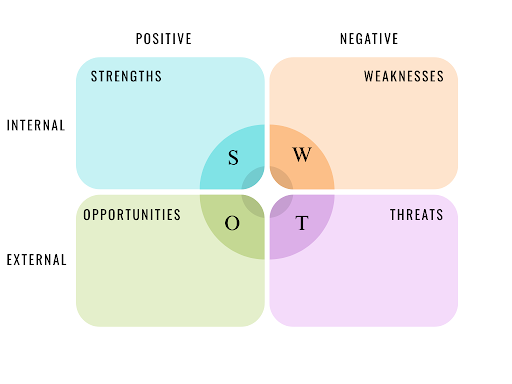
To visualize these insights, most teams use a two-by-two matrix (as shown below). Placing internal factors (strengths and weaknesses) in the top row and external factors (opportunities and threats) in the bottom row. This structure provides a clear overview of the team’s position and makes it easier to translate insights into actionable strategies.
Here are 5 tips to ensure that your team conducts an effective SWOT analysis.
- Include the Whole Team: Gather multiple perspectives to get a complete and honest assessment. It is critical to include members of your organization from each department as well as top to bottom of the corporate ladder.
- Be Realistic and Objective: Avoid overly optimistic evaluations and don’t ignore weaknesses; accuracy is key. To be effective, you must create an atmosphere in which honesty and transparency are prioritized. Each member should feel safe to voice any criticisms or obstacles that they see hindering company performance.
- Support with Data: Use performance metrics, client feedback, or market research to make insights actionable. While everyone’s opinion truly does matter in a SWOT analysis, it never hurts to ensure it’s backed up by real-time data. Encourage team members to pull together evidence to support their feedback.
- Focus on Actionable Insights: Do not just list factors; think about how each item can guide decisions.
- Revisit Regularly: SWOT analysis is most effective when reviewed and updated as conditions change. Your team should incorporate this tool every year. Take the time to discuss how frequently it needs to be completed to ensure that you maintain your competitive edge.
A SWOT analysis helps teams assess performance, make informed decisions, and stay aligned with their goals. When used thoughtfully and updated regularly, it becomes a powerful tool for anticipating challenges and leveraging opportunities.
SWOT analysis two-by-two matrix